

Experience Report
Since the beginning of the third quarter of 2020, in collaboration with both our warehouse staff and our drivers, we have been testing passive exoskeletons to alleviate daily physical strain. The impetus for this test series was the consideration of how to provide employees with the greatest possible support in their work.
The exoskeleton provides employees with supportive and joint-friendly assistance during heavy lifting, thereby preventing long-term health damage. It corrects posture to protect sensitive body regions, such as the spine, from damage caused by incorrect loading. In contrast to active exoskeletons, passive models are characterized by lower complexity and lighter weight, as they contain no drive technology elements. The support for employees' movement sequences is achieved through an intelligent interplay of cable pulls, shock absorbers, and tension and compression springs, optimized to reduce peak forces. Loads are cleverly absorbed and converted into energy, reducing them by up to 40 percent depending on the system.
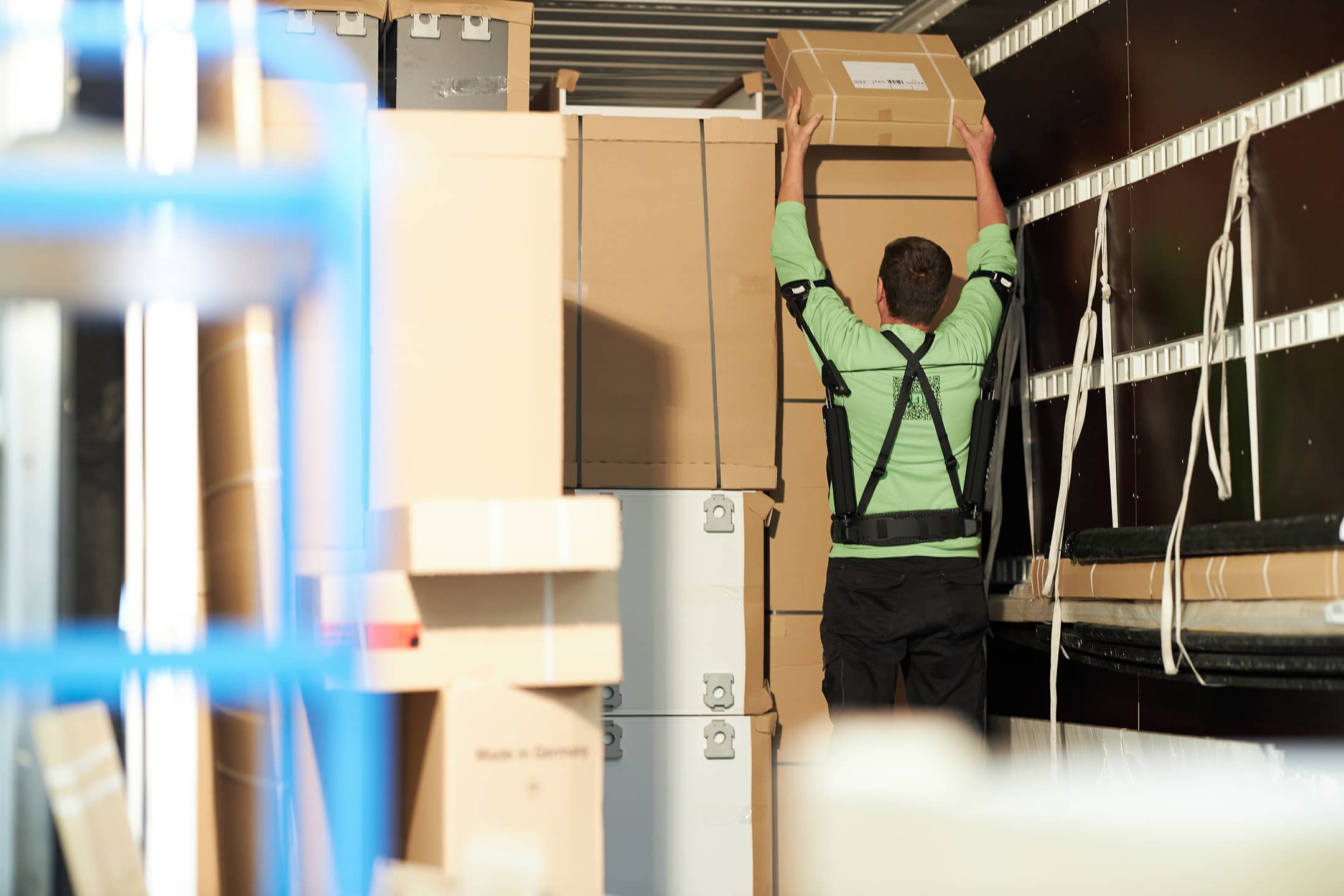
In our test series, we are relying on exoskeletons from Ottobock SE & Co. KGaA, based in Duderstadt. The goal is the permanent implementation of these systems within our company. We are testing three different models with three distinct target mechanisms.
The Paexo Back is designed to relieve strain on the back and spine, the Paexo Shoulder supports the upper body during arm and shoulder strain, including overhead work, and the Paexo Soft Back targets the lower back.
CONCLUSION
Our preliminary conclusion confirms the applications and target areas advertised by the manufacturer. For 2021, further test series are planned, particularly for on-site unloading by drivers and for loading and unloading in our distribution centers, utilizing optimized exoskeleton systems.
To be continued…